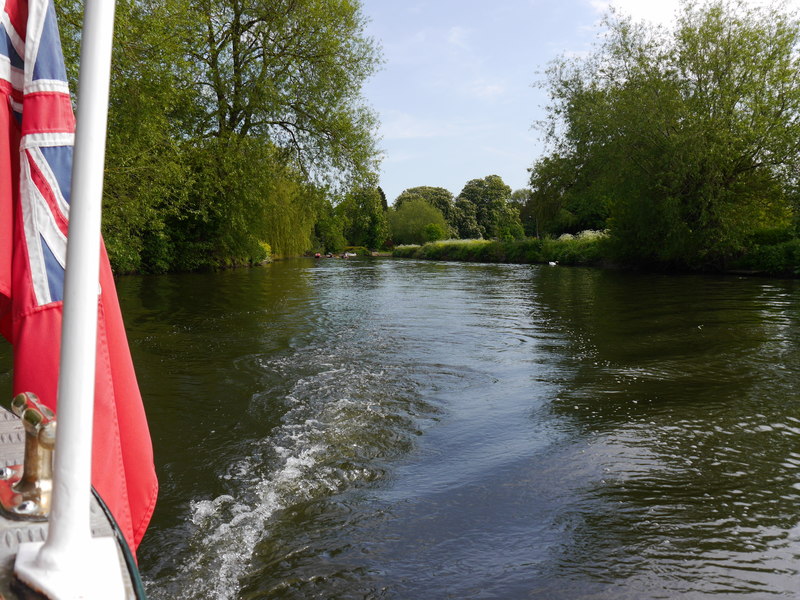
A boat's rippling wake on a river between leafy green banks, with a flag at the left edge.

A landscape journal

Field Atlas

At the water's edge,
the view keeps changing.

Read the field notes
River Ripples / A view from the waterPhotograph by Gordon Griffiths

Along the river

Three short essays on water, banks, and the habit of returning to the same view.

Water

Reading the surface

A river can hold several kinds of movement in a single frame.

The wake in the cover photograph draws a pale, broken path through darker water. Close to the boat, the surface is busy with small bright edges. Farther away, those marks become harder to separate from reflections of the trees and sky.

It is easy to call a river calm when its overall shape looks smooth. A closer view offers a different picture. Ripples cross each other, reflections stretch, and a patch of brightness disappears as soon as the angle changes. Stillness is often a description of the view, not the water.

A photograph makes these different speeds visible together. It records a passing disturbance alongside a bank that appears fixed. The useful question is not only what the water looks like, but which parts of the picture belong to movement and which belong to reflection.

Color alone does not answer that question. A green patch may be a reflected tree rather than something beneath the surface. Looking at its edges, and at how those edges break, gives the image another layer.

Edges

The bank is not a line

On a map, land ends neatly. In a landscape, the meeting is less exact.

From the water, the riverbank looks like a continuous green margin. Look more closely and that margin separates into overhanging branches, grasses, dark spaces beneath roots, and small openings where the light reaches farther inland.

There is no single edge that explains all of it. The visible waterline is one boundary; the reach of the canopy is another. Reflections add a second, shifting version of the same bank, sometimes joining foliage and water into a surface that is difficult to divide.

This is a useful subject for a landscape notebook because it resists a quick label. Instead of writing only "wooded bank," describe one relationship: a branch above its reflection, a bright clearing beside a dense shadow, or the point where a strip of sky first appears.

Such notes need not identify every plant or explain the history of the place. They preserve the shape of an encounter. Specificity can begin with what is plainly visible.

Looking again

A place, revisited

The familiar view is a good place to notice a small change.

A new landscape asks for attention immediately. A familiar one can take longer. We tend to remember its broad arrangement and let that remembered picture stand in for the view in front of us.

Returning to one position interrupts that habit. A branch that once framed the water may be bare. A low sun may reach a patch of bank that was previously in shade. The scene remains recognizable, but the balance of light and texture has shifted.

A pair of photographs is most revealing when their differences are modest. Keep an obvious feature in a similar place within the frame. Record the season and the light if they are known, and leave room for uncertainty when they are not. A darker image does not by itself prove a darker day; exposure can change the story too.

The point is not to make every visit into a comparison. It is to let repetition deepen the view. Sometimes the only new observation is a detail that was there all along.